 Proudly Serving Charleston & Surrounding Areas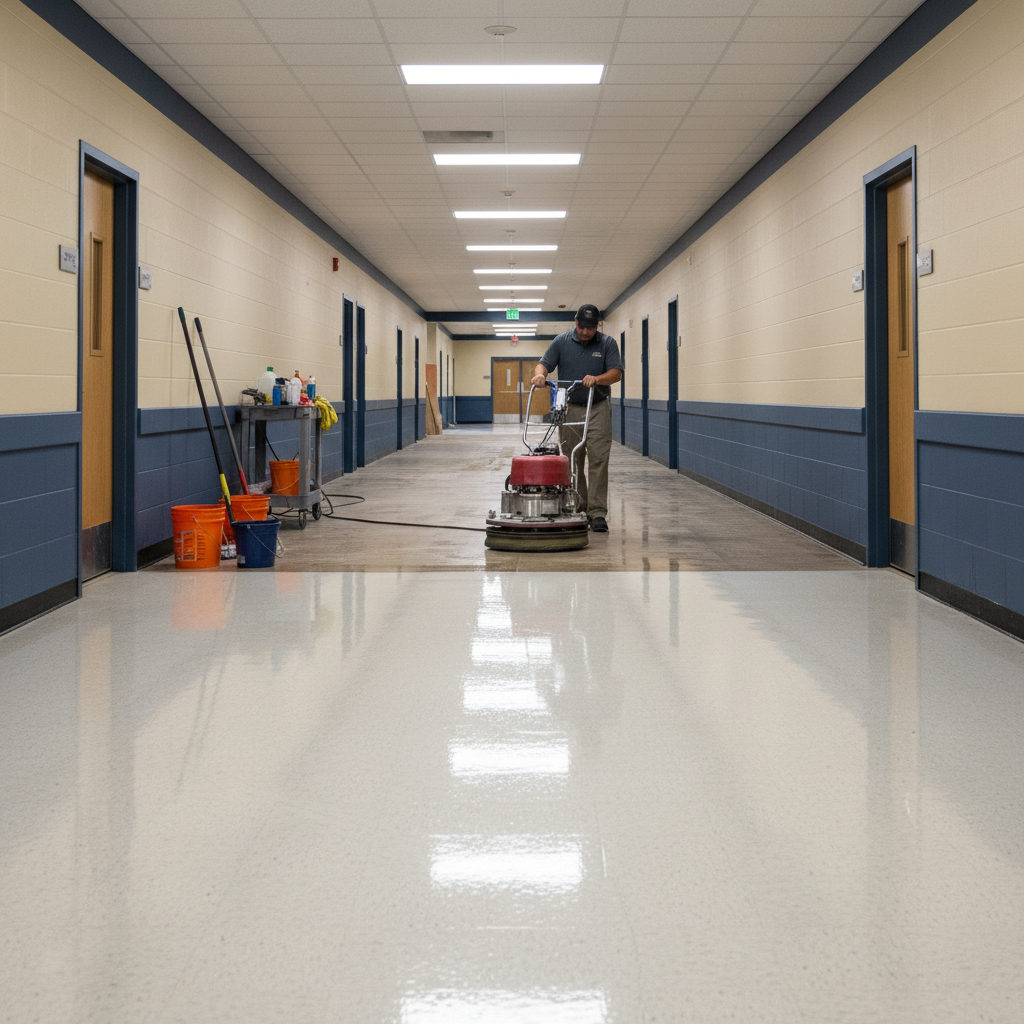
Why strip and wax instead of just polishing?
Polishing (high-speed burnishing of an existing wax layer) restores gloss when the wax is intact and reasonably clean. But once wax accumulates beyond 6–8 coats, yellows from age, traps embedded soil under the surface, or develops cracks and chips, polishing just polishes the damage. The only correct answer at that point is full stripping.
On the Charleston peninsula in particular, humidity drives wax yellowing faster than in lower-humidity markets. Most peninsula commercial floors need full strip-and-wax every 12–18 months rather than the 24-month cycle that works in drier inland markets. Routine quarterly polishing extends the cycle, but it can’t eliminate the eventual need for stripping.
Floor types we strip in Charleston
Active Charleston strip-and-wax work covers VCT (vinyl composition tile) — the most common commercial floor type in the metro — vinyl plank and sheet vinyl, linoleum, and certain rubber and resilient flooring types. Each requires slightly different chemistry and process: VCT tolerates aggressive stripping chemistry; some vinyl plank requires gentler stripping to avoid damaging the wear layer; linoleum requires specifically pH-neutral chemistry to avoid degrading the linseed-oil-based substrate.
We don’t use a one-chemistry-fits-all approach. Crew lead identifies the floor type during walkthrough, selects appropriate stripper concentration and dwell time, and adjusts process accordingly. This is why floor stripping is a specialty service rather than something general janitorial crews handle.
Process: 8 steps from arrival to handover
Our standard Charleston strip-and-wax process is a documented 8-step sequence: (1) furniture moving and floor-edge protection; (2) stripper application and dwell time per floor type; (3) machine scrubbing with appropriate pad aggression; (4) edge and corner detailing by hand; (5) wet-vac extraction and neutralizing rinse; (6) full dry verification with moisture meter; (7) 4–5 coats of commercial-grade floor finish with appropriate dry time between coats; (8) high-speed burnishing of the final coat (where finish formulation supports it) and final walkthrough.
Total project time runs 6–10 hours for typical 5,000–10,000 square foot floors. We schedule starts after business close and finish before opening — typical Friday-night-to-Saturday-morning windows, or full-weekend windows for larger facilities.
After-hours scheduling and zero-downtime delivery
Charleston commercial tenants — particularly retail, restaurants, and medical offices — can’t close for daytime floor work. Our entire strip-and-wax delivery model is built around after-hours scheduling: most projects start at 6pm or later, run overnight, and finish before 7am. Weekend projects start Friday evening and finish before Monday opening.
Furniture moving is included. Floor-edge protection is included. Wet-floor signage during dry windows is included. We coordinate with property management on after-hours building access, alarm protocols, and elevator use for furniture relocation.
Areas regularly serviced
Active Charleston strip-and-wax routes include the peninsula (downtown, MUSC corridor, upper peninsula), Mt. Pleasant (Coleman Boulevard, Johnnie Dodds, Belle Hall), Daniel Island, West Ashley (Sam Rittenberg, Highway 17, Glenn McConnell), James Island, and Johns Island. ZIP codes 29401, 29403, 29407, 29412, 29464, and 29492 are part of our regular Charleston strip-and-wax service area.