 Proudly Serving Charleston & Surrounding Areas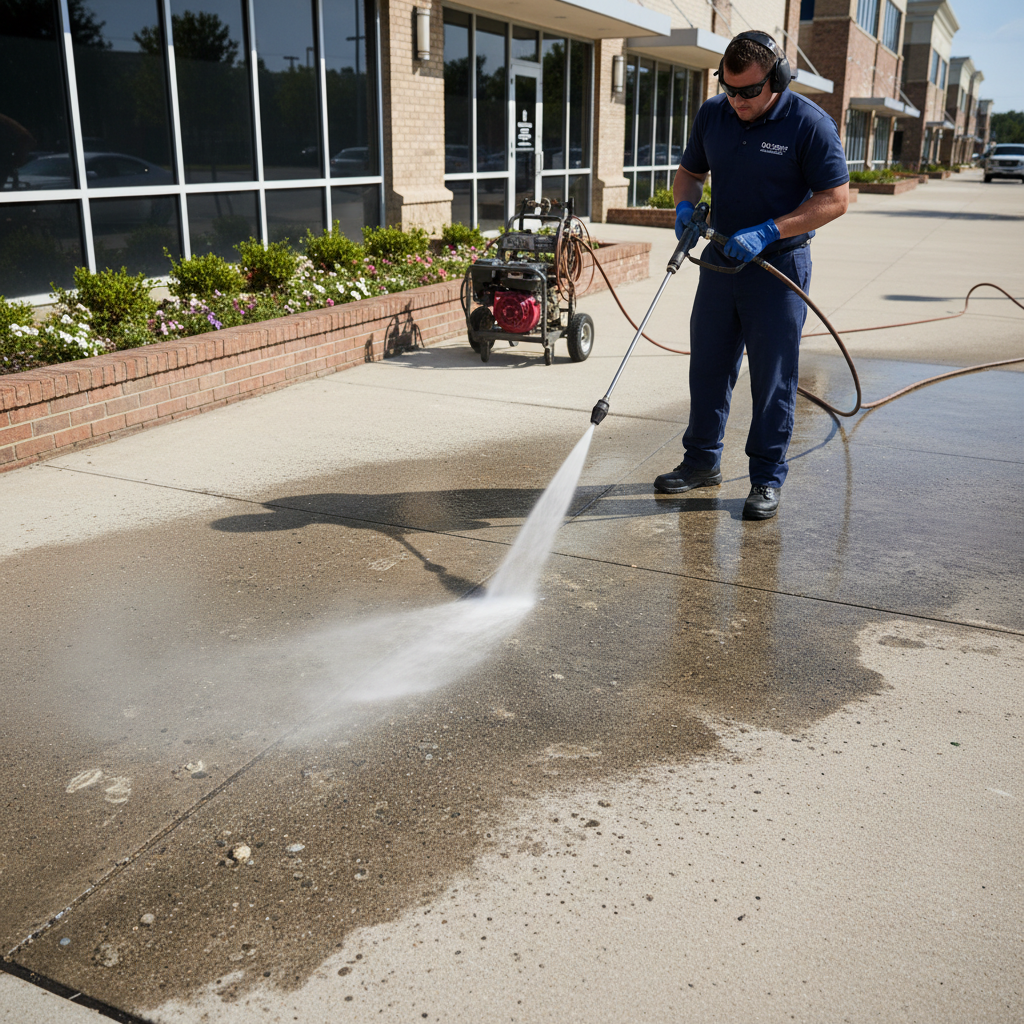
Pressure washing vs. soft washing — when each applies
Pressure washing and soft washing solve different problems with different tools. High-pressure washing (3000+ PSI) cleans hard surfaces — concrete sidewalks, brick walkways, parking lot pavement, dumpster pads, loading docks. Soft washing (under 500 PSI, with cleaning chemistry) cleans softer or more delicate surfaces — vinyl and Hardie siding, stucco, painted facades, historic brick, and shingle roofs.
Using the wrong technique on the wrong surface causes damage. High pressure on stucco etches the surface and removes pigment. High pressure on historic Charleston brick can dislodge mortar and accelerate decay. Low pressure on dumpster pads doesn’t cut through grease and leaves the job incomplete. Crew lead identifies surface type during walkthrough and selects the appropriate method.
Salt-air mildew on Charleston peninsula buildings
Charleston peninsula buildings — particularly within 1–2 miles of the harbor — accumulate biological growth (mildew, algae, lichen) at rates 3–5x higher than inland markets. The combination of salt-saturated air, near-constant humidity, and frequent moisture creates ideal conditions for surface microorganisms to colonize masonry, siding, and even glass.
Standard pressure washing temporarily removes visible growth but doesn’t address the underlying biology. Our soft-wash protocol uses a sodium-hypochlorite-based cleaning solution that kills mildew at the spore level, followed by a low-pressure rinse. Surfaces stay visibly clean for 12–18 months after a single soft-wash treatment, compared to 3–5 months after pressure washing alone.
Historic district and ordinance considerations
Charleston’s historic district has specific protections for original masonry, mortar, and historic woodwork. Pressure washing historic facades requires lower-pressure techniques, mortar-safe cleaning chemistry, and operator experience to avoid damaging irreplaceable surfaces.
We work in the historic district regularly and follow Board of Architectural Review (BAR) and Historic Preservation guidelines. Where surfaces or structures are historically significant, we recommend soft-wash methods with conservative pressure and chemistry; aggressive pressure washing can permanently damage 200-year-old brick or remove painted period detail.
Stormwater compliance
Charleston has active stormwater enforcement, particularly downtown and on the peninsula. Cleaning runoff that flows into storm drains carries detergents, biological contaminants, and dislodged material directly into the harbor and waterways — a violation of city ordinance and Clean Water Act requirements when not properly managed.
Our crews use storm-drain protection (mats, plugs, and reclamation berms where applicable), biodegradable detergents that meet Charleston Water System discharge standards, and reclamation/vacuum systems for sites where runoff containment is required (notably in the historic district and near tidal waterways).
Areas regularly serviced
Active Charleston pressure washing routes include the peninsula (downtown, King Street, Broad Street, the East Bay area, MUSC corridor, upper peninsula), Mt. Pleasant (Coleman Boulevard, Johnnie Dodds, Belle Hall, Shem Creek area), Daniel Island, West Ashley, James Island, and Johns Island. ZIP codes 29401, 29403, 29407, 29412, 29464, and 29492 are part of our regular Charleston pressure washing service area.