 Proudly Serving Charleston & Surrounding Areas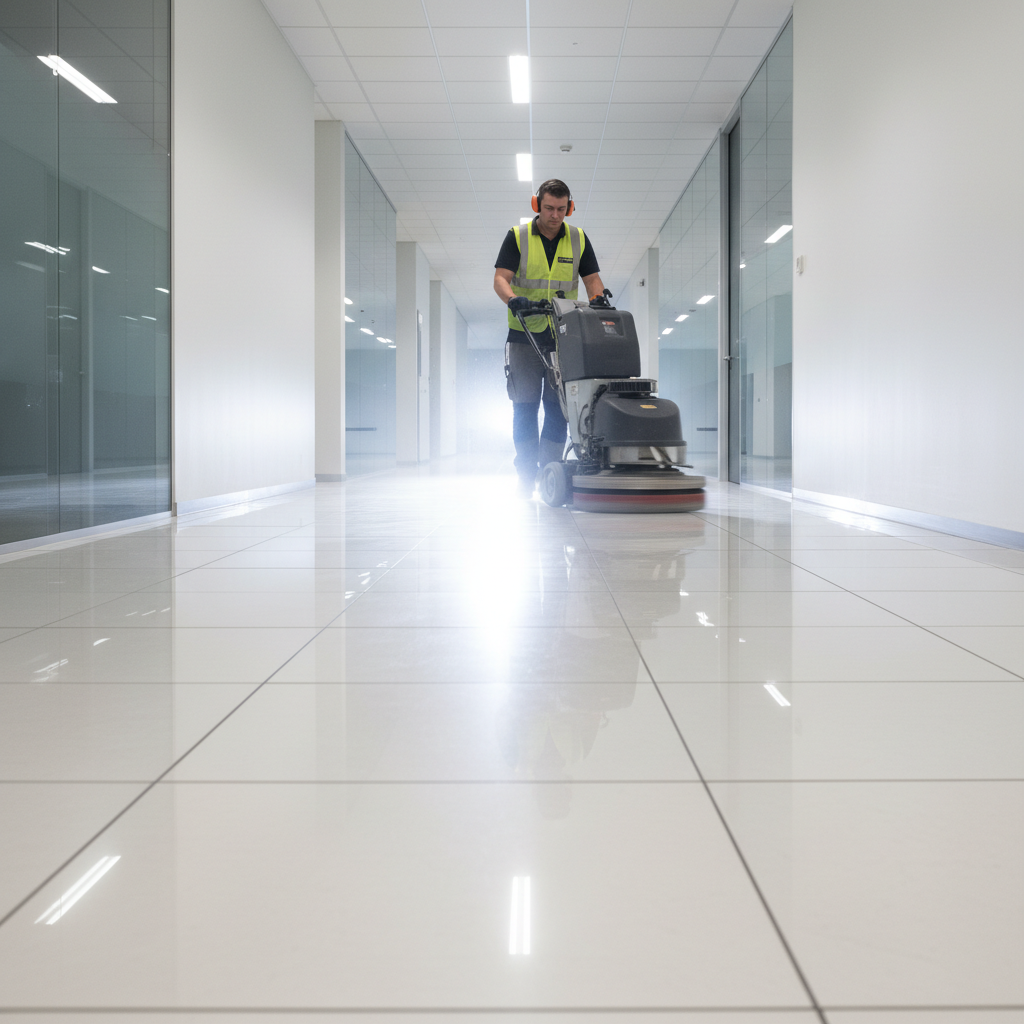
Polishing vs. stripping — when each applies
Polishing and stripping are different services solving different problems. Polishing restores gloss to an existing finish that’s intact but dulled — typical of floors 3–9 months out from their last refinish. Stripping removes finish entirely and rebuilds from bare floor — required when wax has yellowed, accumulated multiple layers, embedded soil, or developed cracks.
Most Charleston commercial floors benefit from both: full strip-and-wax every 12–18 months, with monthly or quarterly polishing in between. The polishing program is what keeps the floor looking inspection-ready year-round; the periodic strip-and-wax is what resets the foundation when polishing alone can no longer recover the appearance.
Floor types and pad selection
Different floors require different pad aggression and burnisher RPM. VCT and vinyl tolerate aggressive pads at 1500–2000 RPM. Terrazzo benefits from lower-aggression pads at higher RPM (2000–2500) to avoid pulling sealer. Polished concrete uses diamond-impregnated pads at lower RPM (1200–1500). Hardwood requires the gentlest pads with careful RPM management to avoid heat damage.
Crew lead identifies floor type during walkthrough and selects appropriate pad and equipment. Using the wrong pad on the wrong floor — too aggressive on terrazzo, too gentle on VCT — produces poor results and can damage the surface. This is why pad selection is operator-dependent rather than something a checklist can dictate.
Routine polishing programs for Charleston
For most Charleston commercial clients we recommend monthly polishing for high-traffic floors (retail entrances, medical office waiting areas, restaurant front-of-house) and quarterly polishing for moderate-traffic floors (professional offices, conference rooms, secondary corridors). Low-traffic floors (executive offices, storage areas) typically don’t need scheduled polishing and benefit more from periodic spot-treatment.
Charleston’s humidity affects polishing scheduling. Burnishing generates heat that softens wax — combined with high humidity, this can cause finish to remain tacky longer than expected. We typically schedule polishing during lower-humidity windows (early morning before peak humidity, or evening as humidity drops) and avoid scheduling during heavy summer afternoon storms when humidity spikes.
Hotel and retail polishing on the peninsula
Charleston peninsula hotels — particularly the boutique properties along Meeting Street, Broad Street, and the East Bay area — frequently maintain weekly polishing programs for lobby, restaurant, and high-visibility public floors. Retail tenants on King Street and on the upper peninsula run similar programs, particularly during the spring tourist season when foot traffic and floor visibility both peak.
Our hotel and retail polishing typically runs overnight (10pm to 6am) to avoid affecting guest or shopper experience. Most projects are 60–120 minutes for typical lobby and front-of-house areas, with the floor fully ready for morning traffic.
Areas regularly serviced
Active Charleston floor polishing routes include the peninsula (downtown, MUSC corridor, upper peninsula), Mt. Pleasant (Coleman Boulevard, Johnnie Dodds, Belle Hall), Daniel Island, West Ashley (Sam Rittenberg, Highway 17, Glenn McConnell), James Island, and Johns Island. ZIP codes 29401, 29403, 29407, 29412, 29464, and 29492 are part of our regular Charleston floor polishing service area.